Rebuilding a +70,000 Employee Intranet from the Ground Up
Role
UX Designer
Duration
3 months · 2023
Team
Service Design, UX, Visual Design
tl;dr
I handled UX for an envisioning project that modernized a major airline's fragmented employee intranet, spanning pre-hire, active employees, and alumni. I owned journey mapping, information architecture, and low-fidelity wireframes across three portals, balancing employee needs with SharePoint and budget constraints. The result was a scalable, out-of-the-box-first portal framework that clarified navigation, reduced friction, and set a clear foundation for implementation.
Pre-flight Safety Instructions
Our team was brought in to modernize three employee portals for a large airline (Contoso Airlines): one for pre-hire candidates, one for active employees, and one for alumni. Their existing system had been built years prior across different platforms, leaving employees confused about where to find resources, contacts, and benefits. The challenge was designing a cohesive intranet that could support over 70,000 active employees.
A previous consulting team had completed an envisioning, but their designs were too custom to implement within budget, leaving Contoso in a difficult position. Our job was to engage key stakeholders across the employee lifecycle and design new portals using as many out-of-the-box SharePoint components as possible.
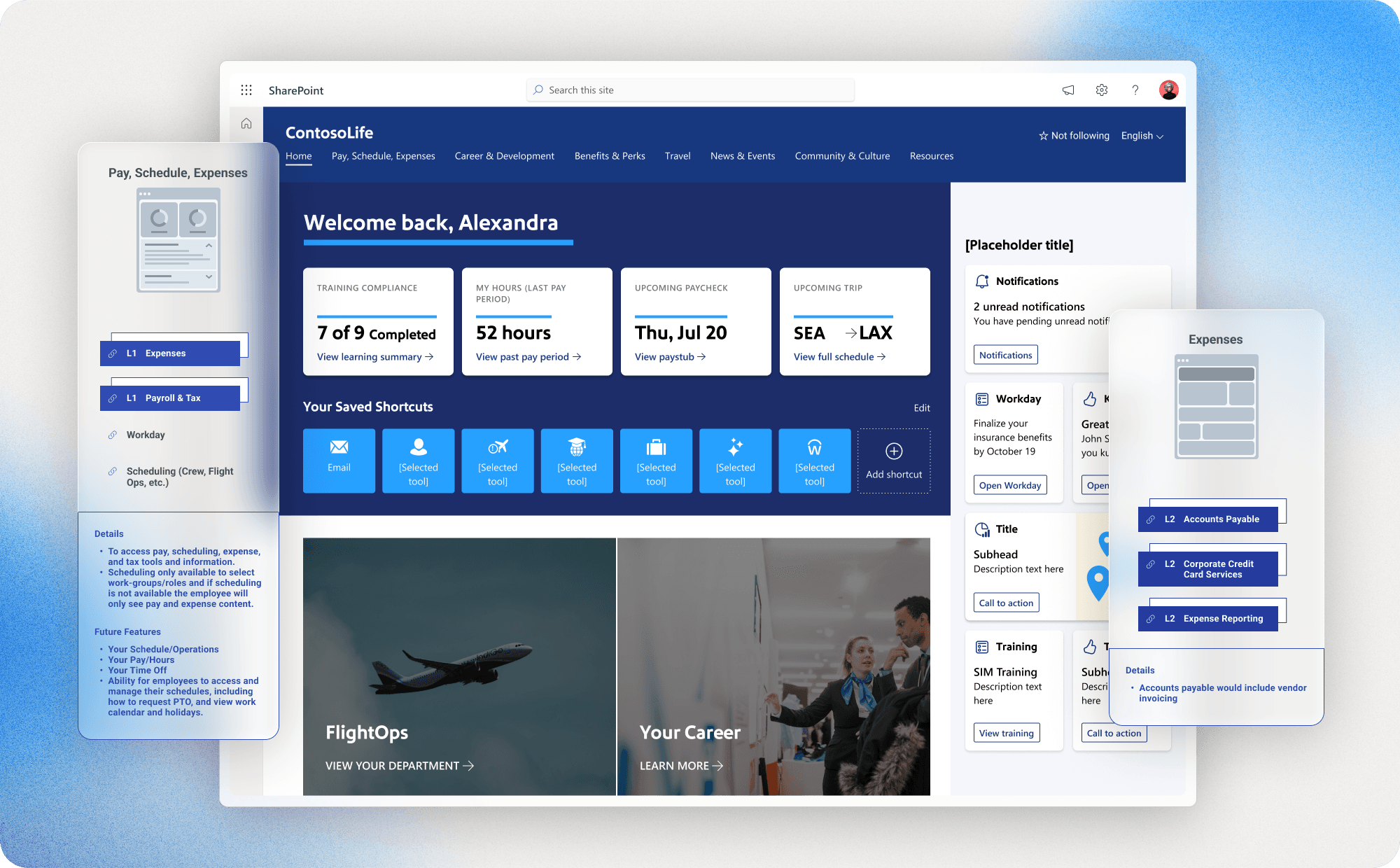
We delivered a full end-to-end employee journey map, a revised site map covering each level of content across all three portals, and both low-fidelity and high-fidelity wireframes for the Pre-Hire, Current Employee, and Alumni experiences. As the primary UX Designer, I was responsible for the journey map, site architecture, and low-fidelity wireframes, while supporting our Visual Design Lead on branding.
Consulting the Cabin
During the engagement, we ran onsite sessions with Contoso Airlines that included a Design Thinking workshop with key stakeholders representing new hires, active employees, and alumni liaisons. I facilitated the session, bringing an early draft of the user journey to workshop collaboratively, surface gaps in our understanding, and identify where different persona groups struggled with overlapping tasks.
Our design team also held several consultations with Contoso's branding team to understand how to apply their visual identity correctly. The Visual Design Lead and I then reviewed the previous wireframes to determine what could be built out of the box and what needed to be reconsidered entirely.
Sorting Through the Luggage
The site architecture was one of the most daunting parts of the project. The existing intranet had sprawled over the years, and before we could redesign it, we needed to understand what was actually there. We aligned early on going at least three levels deep, which gave us a manageable scope without losing the nuance needed to make real navigation decisions.
Rather than asking clients to tell us what it should look like, we always came in with drafts that were detailed enough to be taken seriously but not polished enough to make them feel like they couldn't push back. The goal was to create space for the moments where someone sees something and knows it's not right, and then work together to make it feel right.
.png&w=3840&q=75)
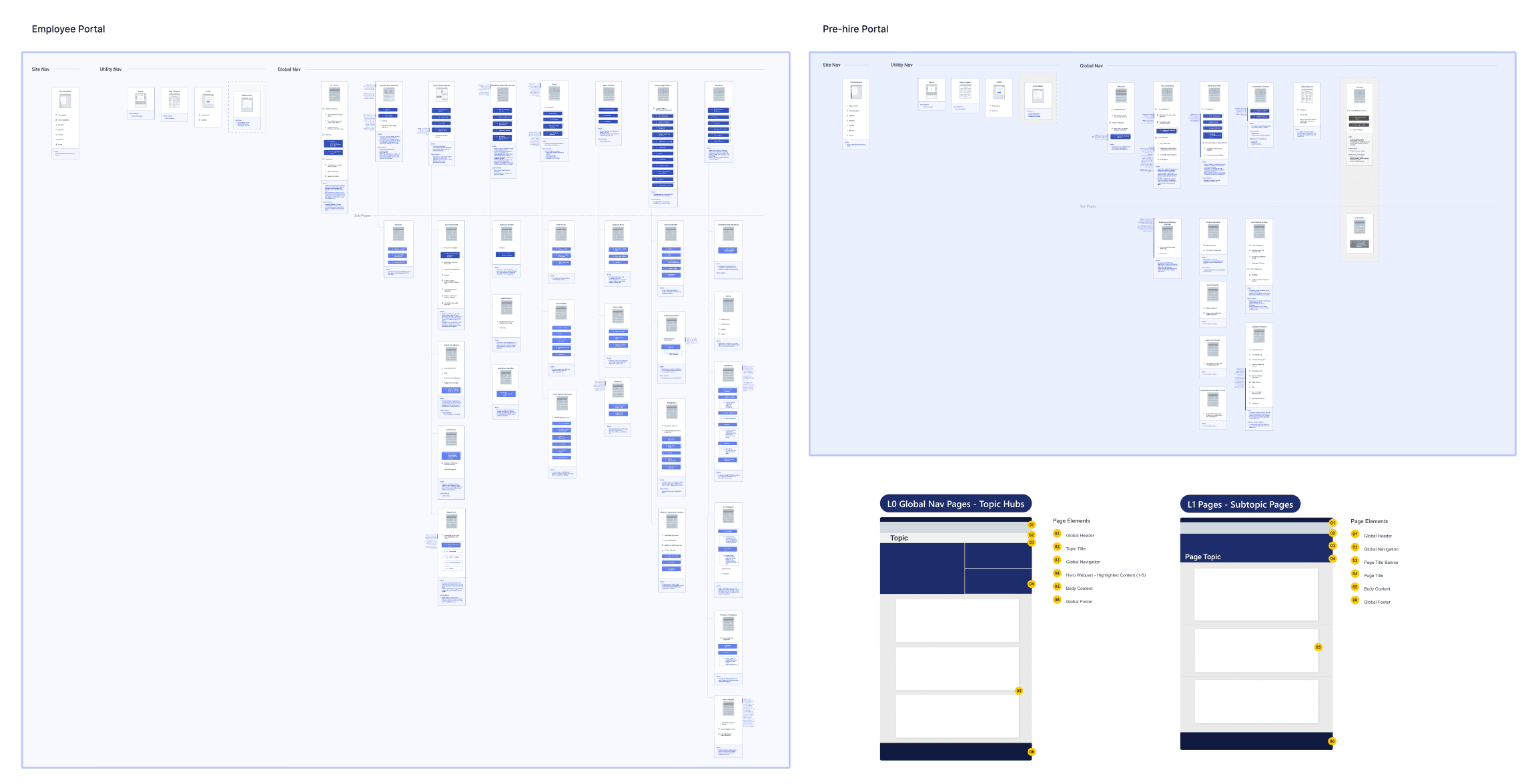
What the employee and pre-hire portal site structure came out to.
(Don't worry, I'm not asking you to squint. Just so you can see what it looked liked at a high level)
Taking Off
We designed screens that would function as templates for the implementation team inheriting the next phase of the project, covering the home screen, department template, travel, company news, and digital tools pages.
The approach was structured around site architecture hierarchy. The higher up you were in the site, the more generalized the content needed to be. The deeper you went, the more the focus shifted from navigation to content. On L0 pages, a large hero section with links to key subpages helped users orient quickly. By the time you reached topic-level L2 pages, the hero stepped back and the content filled the space. The visual treatment at the top of each page became a consistent signal for where you were in the site.
With the UX wires complete, our Visual Design Lead took the work through high-fidelity production. We returned to Contoso for a final deliverable handoff and presentation, closing the engagement with positive feedback and clear momentum for the implementation phase.
Landing
This was the largest design team I had worked on at the time: a Service Design Director, Art Director, Visual Designer, and me as the primary UX Designer. Working in a fully siloed structure pushed me deeper into UX fundamentals: journey mapping, site architecture audits, and low-fidelity wireframes where the goal was communicating functionality, not visual polish.
It also confirmed something about the kind of designer I want to be. Doing only UX work made me appreciate how much I value end-to-end ownership. Getting to see a decision through from research to final screen is where I do my best work.
Client communication was another area of growth. This was one of the first projects where I was directly interfacing with stakeholders, and watching how the leads handled those conversations taught me a lot about pacing, framing, and building trust over the course of an engagement.
The portals have since completed development and are live for Contoso Airlines employees.